
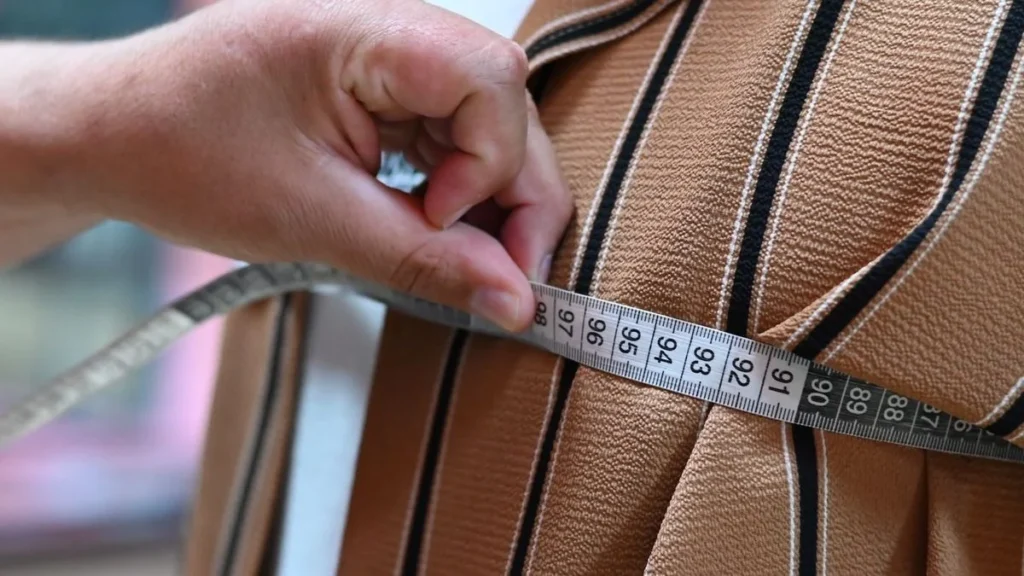
To build an AI size recommendation flow for ecommerce, start with the brand’s chart for the exact product. Identify whether it lists body measurements, finished garment measurements or both. Ask the shopper for the measurements that matter for that item and how they want it to fit. Then compare like with like and explain why a size is a reasonable starting point, rather than promising it will fit.
If two sizes are plausible, show both and explain what the shopper gains or gives up with each. For a fitted jacket, that might be a neater silhouette versus room for a sweater. For a relaxed jacket, the smaller candidate might already give the intended shape. Ask about that trade-off before selecting a size, and confirm the exact variant again before any cart action.
1. Start with the chart for the product being sold
Start with one style, not a universal conversion from letters to measurements. An M in a slim jacket and an M in a boxy jacket are size labels, not promises about either jacket’s dimensions. Even if two products use the same brand body chart, one may be designed to sit close while the other is meant to look loose. Record which chart applies and which fit the product description actually promises.
Label every measurement by what it describes. A body measurement describes the wearer: for example, a chest circumference of 96 cm. A finished garment measurement describes the item: for example, a jacket chest circumference of 99 cm. If the page presents both, keep them separate. A range marked “chest 94–98 cm” cannot be used to calculate room inside the jacket unless the brand explicitly identifies it as a garment measurement.
For each size row, retain the source label, unit, measurement method and any fit notes. A chest width taken across a jacket laid flat is not a chest circumference. Double a flat width only if the brand’s method supports that conversion, and label the result as calculated. Keep a blank cell marked as missing rather than filling it from the next size or from a similar style.
Keep the measurement chart separate from the variant data used to identify a purchasable item. Google Merchant Center’s size attribute communicates the product’s size label; product feed fields such as size system and size type supply context where applicable. They do not tell you the jacket’s chest circumference or replace the brand’s chart. The flow needs both a fit basis and a way to identify the exact size and other options the shopper intends to buy.
2. Ask for the measurements that can change the answer
Decide what would rule out a size before writing the first question. On a jacket intended to close, chest is a useful starting point. Shoulder width or sleeve length can settle the choice between otherwise plausible sizes. On a close-fitting skirt, hip and waist may both matter. Ask for a second measurement when it could change the recommendation, not just because there is another column in the chart.
Give measurement instructions at the point of the question. For a body chest circumference, ask the shopper to wrap a tape around the fullest part of the chest, keeping it level and snug without pulling it tight. Use the brand’s own landmarks or instructions if they differ. Say what the shopper should wear while measuring: if the chart calls for a body measurement, do not silently substitute a measurement taken over a bulky sweater. Ask about the sweater separately.
If the shopper only has a jacket they like, offer a garment-to-garment comparison when the chart supports it. For example, ask them to fasten that jacket, lay it flat and measure across the chest at the same point specified by the brand. Compare that width with the chart’s flat width, or convert consistently if the method permits. This shows how one jacket compares with another; it does not tell you the shopper’s body size.
Normalize units before doing any arithmetic, but show the result in a unit the shopper recognizes. If they say “my chest is 38,” ask whether that means inches around the body or a number from a garment measurement or size label. If the figure puts them close to a cutoff, show the conversion without rounding them into a different size band. A short clarification is more useful than precise-looking math on the wrong input.
3. Use garment ease to explain the recommendation
Garment ease here means the difference between a finished garment measurement and the corresponding body measurement. Subtract the shopper’s measurement from the garment measurement at the same location and in the same units. The result describes how much larger the garment is around that point. It does not tell you how the extra room is distributed, whether the sleeves will be comfortable or how easily the shopper can reach forward.
Illustrative example: a slim jacket
Suppose a shopper has a 96 cm body chest circumference. The hypothetical slim jacket has a finished chest circumference of 99 cm in M and 104 cm in L. The chest calculation is:
- M: 99 cm garment chest minus 96 cm body chest gives 3 cm of chest ease.
- L: 104 cm garment chest minus 96 cm body chest gives 8 cm of chest ease.
Both numbers refer to total circumference; 3 cm is not an extra 3 cm on each side. If the brand describes the jacket as slim, the shopper plans to wear it over a thin top and the shoulders and sleeves check out, M may be the better starting point for the intended shape. If they expect to zip it over a sweater, L gives 5 cm more chest room than M and is worth comparing. That does not guarantee the sweater will fit comfortably underneath.
Explain what could overturn the chest-based choice. If L adds sleeve length the shopper does not want, or M is too narrow at the shoulders compared with a jacket they wear comfortably, say so. Note whether the brand describes the fabric as stretchy, but do not assign it an invented stretch allowance. Likewise, a roomy chest does not resolve a close fit at the hem, a restrictive lining or a narrower cut through the upper arm. When the chart cannot answer one of those checks, call it an unknown rather than presenting the ease figure as a verdict.
4. Change the advice when the cut changes
Illustrative example: a boxy jacket
Now give the same 96 cm shopper a different hypothetical product. This jacket is described as boxy, with a finished chest of 108 cm in M and 114 cm in L. That gives 12 cm of chest ease in M and 18 cm in L. The important comparison is not that M has more ease than the slim jacket’s L. It is that M may already deliver the relaxed shape described for this product.
For a shopper who wants a relaxed jacket over a light top, M is a reasonable starting point if the brand’s guidance and other dimensions agree. If they want a deliberately oversized shape or plan to wear a bulky layer, L remains a candidate. Before recommending it, compare sleeve and body length where those measurements are available. A shopper who asks for more room at the chest may not want a longer jacket.
Do not turn 3 cm, 8 cm or 12 cm into thresholds for other products. The examples show how a flow can explain a choice, not how much room every slim or boxy jacket needs. In particular, if the shopper says a relaxed cut looks too wide, sizing down is not automatically the answer. Ask what they want less of: fabric through the body, length or shoulder drop. If the chart does not show that dimension, flag the uncertainty or suggest comparing a different cut instead of promising that a smaller size will fix it.
Store fit notes at product level so the assistant knows whether “roomy” describes the garment’s intended silhouette or the shopper’s preference. “I want this boxy jacket to look as pictured” and “I want extra room over a thick hoodie” are different requests. The first points back to the brand’s intended fit; the second asks the flow to check layering space and any dimensions likely to become limiting.
5. Make the between-size decision visible
There are two common reasons to keep two sizes in play: a measurement sits near a chart boundary, or different parts of the body point to different rows. In either case, give the shopper both candidates with the relevant measurements, explain the trade-off and ask the one question most likely to settle it. Showing two options is useful only if the shopper can tell why they would choose one over the other.
Illustrative example: waist and hip point to different rows
Suppose a straight skirt has a body chart listing M for a 72–76 cm waist and a 96–100 cm hip, and L for a 77–81 cm waist and a 101–105 cm hip. The shopper measures 76 cm at the waist and 102 cm at the hip. M matches the waist range, but the hip is 2 cm beyond its listed body range. L matches the hip range, but the waist is 1 cm below its listed range. Those figures describe differences from the chart boundaries, not looseness or tightness in the finished garment.
If the skirt is described as close-fitting through the hip and the shopper prioritizes room there, L is the better starting point on the available evidence. Explain that the waistband may not sit as closely as they prefer. If the shopper needs a close waist fit too, ask whether the product has an adjustable waistband only if that detail is unknown and can be checked; better yet, show the documented waistband information if available. Without finished measurements, do not tell them exactly how either size will feel.
For the slim jacket, the deciding question may be as simple as, “Will you usually wear it over a thin top or a sweater?” If the answer is “both,” find out which matters more: the cleaner fit over a top or room to close it over the sweater. If the shopper cannot choose a priority, leave both sizes visible. And if the preferred size is unavailable, say so separately; stock status does not make the other size a better fit.
6. Give partial answers when the chart is incomplete
A body-only chart can still support a recommendation: “Your 96 cm chest falls in the brand’s M body range.” It cannot support “M gives you 3 cm of room.” Conversely, a garment-only chart can support the ease calculation if the shopper supplies a comparable body measurement, but it does not establish the brand’s recommended body range. Make the difference visible in the answer, not just in the data used behind the scenes.
Check whether the gap affects the decision. If sleeve length is missing and the shopper is choosing between sizes because their usual jackets run short in the arms, chest alone will not resolve it. If a selected variation has no chart, use the brand’s standard chart only when you can explain why it is a reasonable reference. For example, if the store identifies that variation as the same cut and points to the shared body chart, say that your recommendation uses the shared chart and that you do not have variation-specific garment measurements.
If two sources disagree, do not average them. First check whether one is a body range and the other is a finished measurement, whether they use different units or whether they refer to different variations. If the conflict remains, pass the question to the store’s team or explain what the shopper should verify. A useful handoff names the product and variation, the candidate sizes and the missing or contradictory figure. “Can you confirm the finished chest circumference of this lined jacket in M?” gives the team something specific to check.
7. Keep voice selection, cart action and payment separate
A voice interaction needs the same fit logic as a typed interaction, plus a read-back of anything that could have been misheard. If a shopper says “ninety-six,” confirm “96 centimeters around your chest” before calculating. After discussing M and L, “I’ll go with large” identifies the chosen size. It is not, by itself, acceptance of a cart action. Keep the choice available for review, especially if the shopper changes the color, cut or another option that affects the variant.
Before the cart action, repeat the product, size and any other options necessary to identify the item. For an illustrative exchange, say: “You chose the slim jacket in navy, size L, for room over a sweater. Add that jacket to your cart?” The shopper’s affirmative response to that specific request is acceptance of the cart action. Report that it was added only when the store confirms the action succeeded. Adding to a cart does not mean payment was authorized, taken or completed; those belong to checkout.
Apply the same distinctions when describing examples. A mock preview can illustrate a voice selection, a confirmation prompt or a cart step. It is not proof that a live cart changed or that a payment occurred. For Senoji Baldinė, attribute the workflow account to the owner. Treat the public product listing as evidence only for product details it actually displays. The listing alone does not verify the owner-described interaction, the shopper’s acceptance of a cart action or a completed payment.
8. Test the decisions before adding more products
Test one product at a time, with the brand’s chart open and the expected response written down. Use cases where a wrong answer could still sound reasonable: a 49.5 cm flat jacket width that is mistaken for circumference, a body chart read as finished dimensions, or a missing L measurement copied from another cut. Check the explanation as well as the suggested size. A correct label reached by comparing the wrong figures is still a failure.
- Clear fit: Use a measurement well inside a documented body range. Check that the answer names the range and does not invent garment ease.
- Cut and layering: Run the same 96 cm chest through the slim and boxy examples. Change a thin top to a sweater and check that the assistant revisits the trade-off rather than mechanically sizing up.
- Boundary input: Use a value on a size boundary, then enter its equivalent in another unit. Check that the recommendation is consistent and any ambiguity stays visible.
- Conflicting measurements: Give a waist that matches M and a hip that matches L. Check that both candidates are shown and the limiting dimension is named.
- Incomplete data: Remove the shoulder or sleeve measurement that would settle a jacket decision. Check that the answer narrows its claim instead of borrowing an unverified figure.
- Cart confirmation: Select a size by voice, change the variant, then accept the cart action. Confirm that the final read-back and cart request refer to the new variant and that neither is described as payment.
Repeat the relevant tests whenever a chart changes or a new variation is added. Record which chart and version supplied the answer so that a sizing complaint can be traced to what the shopper saw. If the storefront and sizing flow show different figures, fixing the mismatch is more important than improving the wording around the recommendation.
9. Measure whether the flow resolves fit questions
Track the points where shoppers get stuck: how often they cannot supply the requested measurement, how often two candidates remain after the follow-up question and how often the flow hands off because a chart is incomplete. Review those numbers by product and cut. If shoppers repeatedly ask what “chest width” means, fix the measurement prompt. If they keep asking about shoulders on a particular jacket, check whether the product team can provide a shoulder measurement and its method.
Keep sizing decisions and shopping actions distinct in reporting. Count a suggested size, a shopper-selected size and a successful cart addition as separate events. Where the store records exchanges or returns, review fit-related reasons by style and size when there is enough information to do so. An increase in cart additions does not show that advice improved fit, and an exchange marked only “too small” does not identify whether the chest, shoulders or sleeves caused the problem.
Start with changes the store can verify: correct a mislabeled chart, add a measurement the team can reproduce, or rewrite a question that confuses body and garment figures. A good recommendation should leave the shopper able to explain the decision in their own words: which size they chose, what makes it more suitable for their intended fit and what remains uncertain before they add it to the cart.
Related guides
- How clothing stores can offer virtual try-on from a photo
- How to test a virtual fitting room before launch